
Table of Contents
Introduction | CQI-27
The work of preparing CQI-27 Special Process: Casting System Assessment was carried out through the Automotive Industry Action Group (AIAG) casting work group.
The Casting Assessment System can be used to assess an organization’s ability to meet the requirements in the assessment, as well as customer, regulatory, and the orgainzation’s own requirements.
The Casting System Assessment can also be used between an organization and its suppliers.
CQI-27 is just one piece of this larger puzzle, but it zeroes in on casting—a process that has been around for centuries but still poses challenges in quality and reproducibility.
Process Approach of CQI-27 Casting System Assessment
CQI-27 Casting System Assessment supports the automotive process approach as described in IATF 16949 Quality Management System Standard.
Goals of CQI-27 Casting System Assessment
The main objective or goal of CQI-27 Special process: Casting System Assessment is the development of strong casting process by eliminating the common root causes of casting problems or casting defects.
Casting Assessment Process
CQI-27 Assessments shall be conducted yearly, unless otherwise specified the customer, to reexamine the continuing compliance with the Casting System Assessment. The assessment shall use the process approach for auditing or assessing as per IATF 16949 standard requirements.
CQI-27 Importance in the Automotive Industry
Why do we even need a special casting assessment? Because casting is not just simple like machining or welding process. It’s very complex, hot, raw, and foundational. Minor defects or flaws can mean catastrophic failures. For this reason, Original Equipment Manufacturers (OEMs) want evidence that suppliers are not just doing casting, but doing it correctly.
Scope of CQI-27 Casting System Assessment
CQI-27 applies to any automotive components manufacturer or supplier involved in:
- Aluminium High-Pressure Die Casting
- Zinc High Pressure Die Casting
- Magnesium High Pressure Die Casting
- Low-Pressure Die Casting
- Sand Casting – Iron/Steel
- Aluminium Sand Casting
- Investment Castings – Iron/Steel
- Centrifugal Castings
- Centrifugal Liners
- Permanent mold casting
This assessment is for you, if casting is a part of your process, whether you’re making structural parts, engine blocks, transmission housings, or cylinder blocks.
CQI-27 Document Structure
The CQI-27 is not just a manual; it’s a structured checklist and framework that walks you through:
- Management systems standards
- Process controls
- Operator training
- Measuring Equipment calibration
- Quality assurance and control
CQI-27 Applications | Process Tables
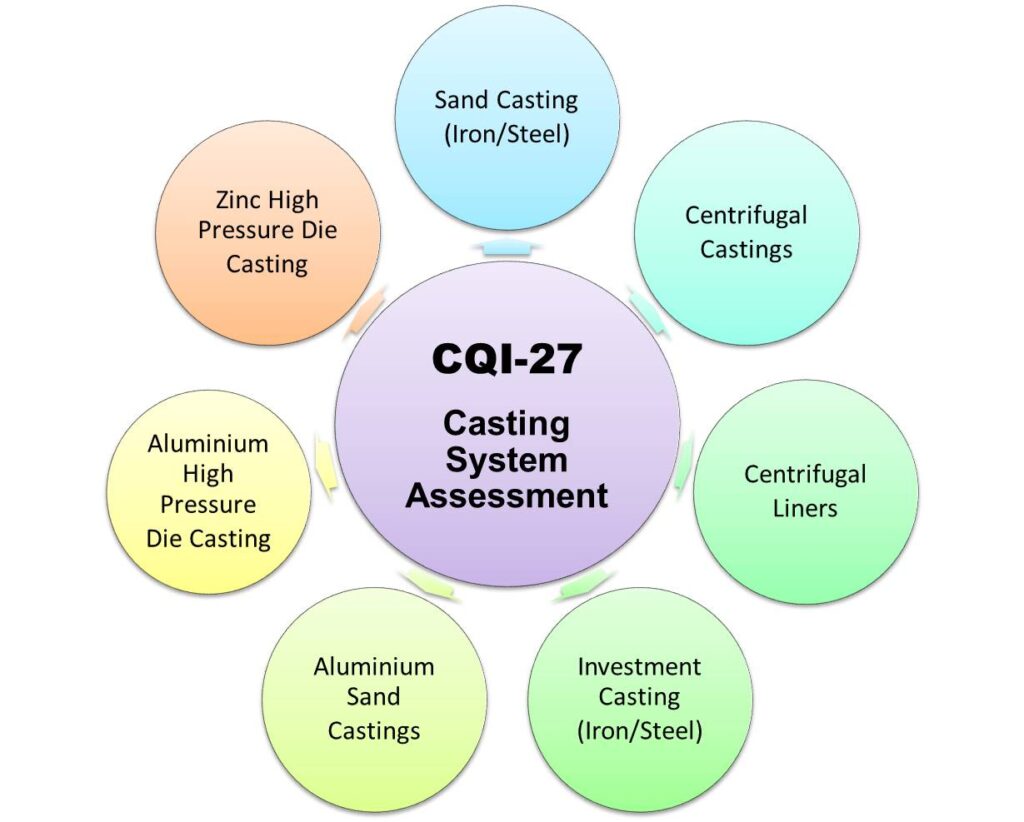
There are 10 process tables have been developed by AIAG that is to be referred during the casting system assessment.
- Process Table A | Sand Casting (Iron/Steel)
- Process Table B | Centrifugal Castings
- Process Table C | Centrifugal Liners
- Process Table D | Investment Casting (Iron/Steel)
- Process Table E | Aluminium SPM Cylinder Heads
- Process Table F | Aluminium Sand Castings
- Process Table G | Aluminium Metal Mold
- Process Table H | Aluminium High Pressure Die Casting
- Process Table I | Magnesium High Pressure Die Casting
- Process Table J | Zinc High Pressure Die Casting
Process Table A | Sand Casting (Iron/Steel)
The Sand Castings requirements/categories/process steps included in process table A are:
- Casting Design and Tooling
- Metal Control
- Magnesium Treatment
- Cores Cold Box, Hot Box and Shell)
- Molding/Pouring/Casting Operation
- Casting Cleaning and Finishing
- Casting Inspection and Testing
- Material Properties
- Leak Testing
Applications: Includes Grey iron, ductile iron, steel castings, and compacted graphite iron. There is a wide variety of molding processes including green sand, air set bonded sands, shell molding, and stacking molding.
Process Table B | Centrifugal Castings
The Centrifugal Castings requirements/categories/process steps included in process table B are:
- Casting Design and Tooling
- Metal Control
- Magnesium Treatment
- Metal Control
- Spinners
- Pouring
- Extraction
- Processing and Inspection
- Material Properties
- Leak Testing
Applications: Includes ductile iron, grey iron, and steel castings (except centrifugal liners which has its own table). The process ranges from highly automated cells to labor intensive process flows.
Process Table C | Centrifugal Liners
The Centrifugal Liners requirements/categories/process steps included in process table C are:
- Casting Design and Tooling
- Metal Control: Process steps include- Incoming/Return Material storage, Charging Materials, Alloy addition, Metal Chemistry
- Metal Control- Process steps include- Equipment, Startup process, Metal Transfer, Metal Pouring, Batch Pour System, Metal Quality, Alloying, Machine Setting, and Control Limits
- Spinners
- Pouring
- Extraction
- Processing and Inspection
- Material Properties
Applications: Grey iron centrifugal cast cylinder liners used in cylinder blocks for automotive applications. The liners may be pressed-in-place (PIP) or cast-in-place (CIP). It ranges from highly automated cells to labor intensive process flows.
Process Table D | Investment Casting (Iron/Steel)
The Investment Castings requirements/categories/process steps included in process table D are:
- Casting Design and Tooling
- Wax Injection
- Cluster Assembly
- Cluster Coating (Shelling)
- Wax Removal
- Prebake (Burnout)
- Metal Control
- Metal Pouring
- Casting Testing and Inspection
- Material Properties
- Leak Testing
Applications: Casting from processes commonly called investment casting, lost wax, or precision mold. It ranges from highly automated cells to labor intensive process flows. A wide variety of cast irons and steel alloys.
Process Table E | Aluminium SPM Cylinder Heads
The Aluminium SPM Cylinder Heads requirements/categories/process steps included in process table E are:
- Casting Design and Tooling
- Cores (Cold Box, Hot Box, and Shell)
- Cast Machines
- Metal Control
- Pouring
- Low Pressure Casting Process
- Post Processing and Heat Treatment
- Inspection and Testing
- Material Properties
- Leak Testing
Applications: The semi-permanent mold process may include different types of cast machine equipment such as: gravity die casting, tilt pour, rotory, and low pressure die cast.
Process Table F | Aluminium Sand Castings
The Aluminium Sand Castings requirements/categories/process steps included in process table F are:
- Casting Design and Tooling
- Cores (Cold Box, Hot Box, and Shell)
- Metal Control
- Cast In Place Insert
- Molding/Pouring/Casting Operation
- Post Processing and Heat Treatment
- Casting Inspection and Testing
- Material Properties
- Leak Testing
Applications: There is a wide variety of molding processes including green sand, air set bonded sands, shell molding, stacking molding, precision sand core packages.
Process Table G | Aluminium Metal Mold
The Aluminium Metal Mold requirements/categories/process steps included in process table G are:
- Casting Design and Tooling
- Cores (Cold Box, Hot Box, and Shell)
- Cast Machines
- Metal Control
- Cast In Place Inserts
- Pouring
- Low Pressure Casting Process
- Post Processing and Heat Treatment
- Inspection and Testing
- Material Properties
- Leak Testing
- Piston Specific
Applications: Aluminium semi-permanent mold and permanent mold castings (except Cylinder Heads which has its own table). Includes pistons, aluminium alloy wheels, Cast processes include different types of equipment such as: gravity die casting, tilt pour, rotory, low pressure die cast, and pressure counter pressure.
Process Table H | Aluminium High Pressure Die Casting
The Aluminium High Pressure Die Casting requirements/categories/process steps included in process table H are:
- Casting Design and Tooling
- Cast Machines
- Start Up Procedures
- Metal Control
- Cast In Place Inserts
- Pouring/Casting Operations
- Processing and Inspection
- Material Properties
- Leak Testing
Applications: Includes conventional high pressure die casting, horizontal and vertical squeeze casting, semi-solid, and similar variants of die casting.
Process Table I | Magnesium High Pressure Die Casting
The Aluminium High Pressure Die Casting requirements/categories/process steps included in process table I are:
- Casting Design and Tooling
- Ingot Supplier
- Cast Machines
- Start Up Procedures
- Metal Control
- Casting Inserts (if applicable)
- Pouring/Casting Operation
- Inspection and Testing
- Material Properties
- Leak Testing
Applications: Includes conventional high pressure die casting, horizontal and vertical squeeze casting, and similar variants of die casting.
Process Table J | Zinc High Pressure Die Casting
The Zinc High Pressure Die Casting requirements/categories/process steps included in process table J are:
- Casting Design and Tooling
- Ingot
- Metal Control
- Cast In Place Inserts
- Cast Machines (General)
- Cast Machines (Hot Chamber)
- Cast Machines (Cold Chamber)
- Processing and Inspection
- Material Properties
- Leak Testing
Applications: Includes cold chamber and hot chamber die casting of zinc alloys.
Source: CQI-27 Special Process: Casting System Assessment Standard, 2nd Edition, Issued 3/2018 by AIAG