
Check Sheet is also called as Tally Sheet. It is a structured or prepared form used for recording, collecting, and analyzing data in a organized and systematic way.
A Check Sheet is mainly used for collecting data (data can be in the form of observations, opinion, and numerical) in real-time at location where the data is generated.
This is the basic and very important tool of 7 QC Tools and is extensively used in Problem Solving Techniques such as 8D, PDCA and measure phase of Six Sigma.
Table of Contents
WHEN TO USE CHECK SHEET
For collecting real-time data from production processes. For example, Production data recording check sheet – part wise, model wise, machine wise and operator wise.
To distinguish between fact & opinion.
To collect data about the type of problem/defects/rejection or non-conformance.
When the data collection required from different machines, parts, models, shifts, persons and locations etc.
When to record product and process related parameters against defined work standards to ensure quality.
BENEFITS OF CHECK SHEET
Helps to analyze the data for corrective and preventive actions.
Helps in making the Bar graph, Histogram, and Pareto Chart.
Helps to take decision at a glace to control the product and process related non conformance.
Helps to detect how often a problem occurs.
It facilitates systematic record keeping or data collection.
EXAMPLES
Date wise and defect wise rejection monitoring check sheet.
An example given below, shows at a glance that the major rejection contributing defects are Blow hole and crack and high rejection is on dated 1 and 2.

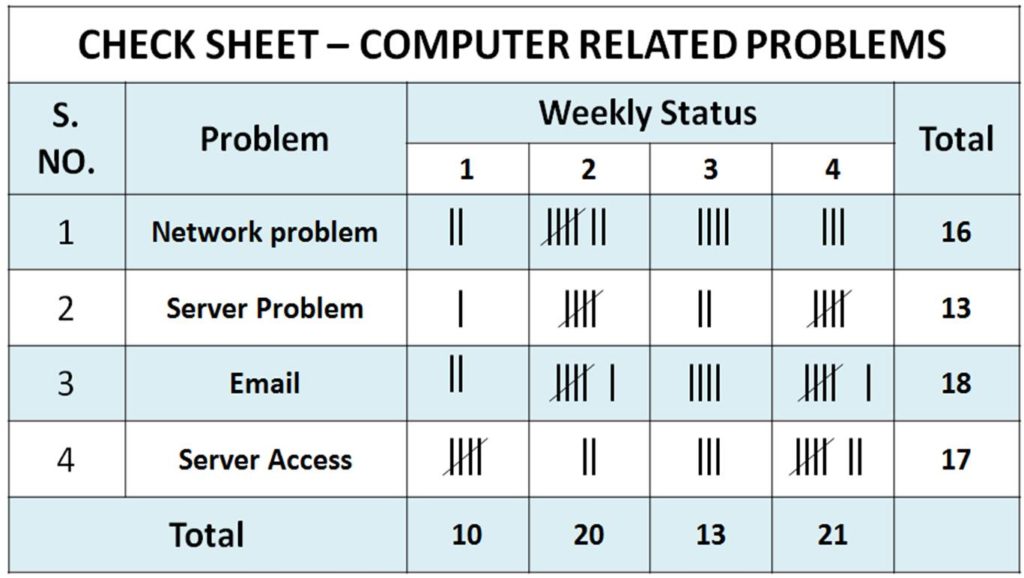
Computer related problem check sheet that shows the weekly status of problems.
An example given below, shows at a glance that the major problem are related to Email and Server Access and last fourth week having the maximum problem.
PROCEDURE TO USE
Bring clarity of understanding in the events or conditions under study.
Decide responsibility, duration and sources for Data collection.
Check sheet form is to be simple to use, easy to understand and complete in all respects for accurate data collection.
CHECK SHEET KEY ELEMENTS
- Title of check sheet
- Observation Date, Time or shift
- The part or event name
- Tally marks/checkmarks for frequency
- Total counts or sum at the end
- Person name who is responsible for data collection
CHECK SHEET TYPES
- Quality Defect Inspection Check Sheet: to record defective parts with name and quantity.
- Frequency Check Sheet: to check how often an event or problem/defect occurs.
- Checklist: to verify the work or tasks or actions are completed as per defined checklist.
- Measurement Check Sheet: to record measured or observed values over a period of time.