
Mean Time To Repair (MTTR) and Mean Time Between Failure (MTBF) are the two most important key performance indicators or metrics that are used in the Maintenance process or reliability engineering to measure the performance of machines and equipment. MTTR and MTBF KPIs tools are widely used by the Lean Manufacturing industries and IATF 16949-certified Automotive industries to enhance Overall Equipment Effectiveness.
Mean Time To Repair and Mean Time Between Failure KPIs are very useful Lean Tools of manufacturing industries.
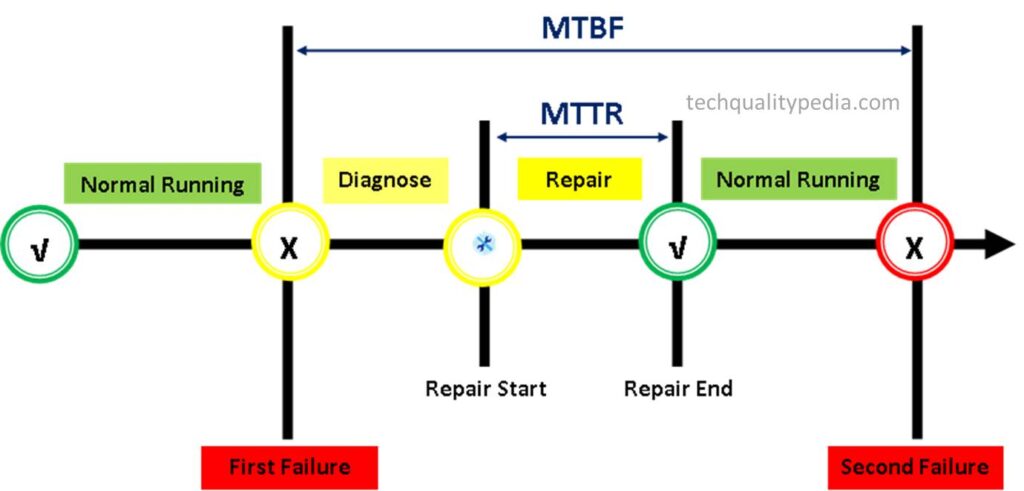
Table of Contents
MTBF | MEAN TIME BETWEEN FAILURE
It is the average time between two failures of the same system or component. It is calculated by dividing the system’s overall uptime or Available Operational time by the number of failures.
- The MTBF KPI monitors the availability and reliability of an equipment/machine.
- The system is more reliable if the time between failures is higher.
- The goal for most organizations is to maintain the mean time between failure (MTBF) higher as much as possible.
- This metric is used for failures in repairable systems.
MTBF Formula | MTBF Calculation
Formula MTBF = Operational Time / No. of breakdowns or failure.
[Operational Time = Available Time – Breakdowns or Downtime hours]
Mean Time Between Failure is calculated using an arithmetic mean. The data you can choose from any period (one week, one month, six months, one year, or more ) and divide that period’s available operational time by the number of breakdowns or failures that occurred in a particular period.
Let’s calculate the available hours of one machine in one month.
Machine Available Time = 3*8*25= 600 hours [3 shifts of 8 hours X no. of working days in a month]
No. of breakdowns occurred in a month = 2 Nos. [ 2hrs and 3 hrs each ]
Total Breakdown hours = 5 hours
Actual Operational time = 600-5 = 95 hours
MTBF = 600-5/2 = 297.5 hours
MTTR | MEAN TIME TO REPAIR
It is the average time to repair a machine or equipment after failure/breakdown. It is calculated by dividing the total repair time or total breakdown time of the machine or system by the number of repairs or the number of breakdowns. MTTR is also called the Mean Time To Recovery.
MTTR Formula | MTTR Calculation
Formula MTTR = Breakdowns or Repairs or Downtime hours of machine or system / No. of breakdowns or failures or Repairs
Let’s Say,
No. of breakdowns that occurred in a month = 2 Nos. [ 2hrs and 3 hrs each ]
Therefore, total breakdown hours = 5 hours
MTTR = 5/2 = 2 hours
Principles of MTBF and MTTR
The principles of MTTR and MTBF are classified into three categories:
- RELIABILITY
- AVAILABILITY
- MAINTAINABILITY
RELIABILITY
The probability of the machine or component performing its required function for a stated interval of time under stated condition.
AVAILABILITY
The working period or stated period of time for which an item is available.
MAINTAINABILITY
The probability of an machine or component to get repaired through maintenance to an actual state within a given time
How to Improve MTBF and MTTR?
To improve MTBF and MTTR, you must focus on enhancing the maintainability, reliability and performance of your equipment, systems, and processes. Here’s a clear breakdown of strategies to improve MTBF and MTTR:
How to Improve MTBF?
MTBF measures system reliability- how long equipment runs without failure. To increase MTBF, focus on preventing measures and design improvement.
1. Implement Preventive and Predictive Maintenance
- Schedule regular cleaning, inspections, tightening, lubrication, and replacements of parts.
- Use condition-monitoring tools to anticipate breakdowns or failures e.g. vibration, temperature, etc.
2. Improve Equipment Design and Quality
- Select robust, industrial-grade components.
- Redesign weak links.
3. Analyze Breakdown/Failure Data
- Use FMEA and 5Why to identify real root causes of the failure.
- Update maintenance check sheets and plans based on failure trends and actions taken.
4. Improve Operating Conditions
- Ensure systems are run within the specified temperature, load, and pressure limits.
- Reduce environmental stressors such as dust, moisture, vibration etc.
5. Train and Educate Machine Operators
- Ensure proper usage of tools and equipment by operators.
- Misuse or poor handling may lead to major failures.
How to Improve MTTR?
MTTR reflects how quickly a system or equipment can be restored after a failure. To reduce MTTR (i.e., improve it), focus on fast and efficient maintenance.
1. Standardize Maintenance Procedures
- Create clear, step-by-step Standard Operating Procedures (SOPs) for all repair tasks.
- Include troubleshooting guides, spare part numbers, and escalation paths.
2. Train Staff and Technicians
- Regularly train maintenance teams on equipment diagnostics, troubleshooting, and repair techniques.
- Conduct regular mock drills and simulations for quick fault identification.
3. Improve Fault Detection and Diagnostics
- Use smart sensors and IoT for real-time monitoring and alerts.
- Implement Root Cause Analysis (RCA) tools for accurate diagnosis.
4. Ensure Availability of Critical Spare Parts and Tools
- Maintain minimum and maximum level inventory of critical spare parts.
- Use Computerized Maintenance Management Systems to track availability and reorder levels.
5. Use Predictive Maintenance
- Apply predictive analytics to foresee potential failure or breakdowns.
- Address problems before they lead to major downtime.