
The Quality Core Tools are also known as Automotive Core Tools & IATF Core Tools. These tools are widely applied by automotive and other manufacturing industries to provide high-quality products & to meet the customer’s expectations.
The Automotive Core Tools are five quality methodologies or techniques that support the expectations/requirements of the IATF 16949 Quality Management System standard for continuous improvement.
Table of Contents
What are the Quality Core Tools?
The Core Tools of Quality are five techniques/methods that support the requirements & expectations of the IATF 16949:2016 quality management system standard.
The 5 Quality Core Tools are documented separately & the manuals of each core tool are published through the Automotive Industry Action Group (AIAG).
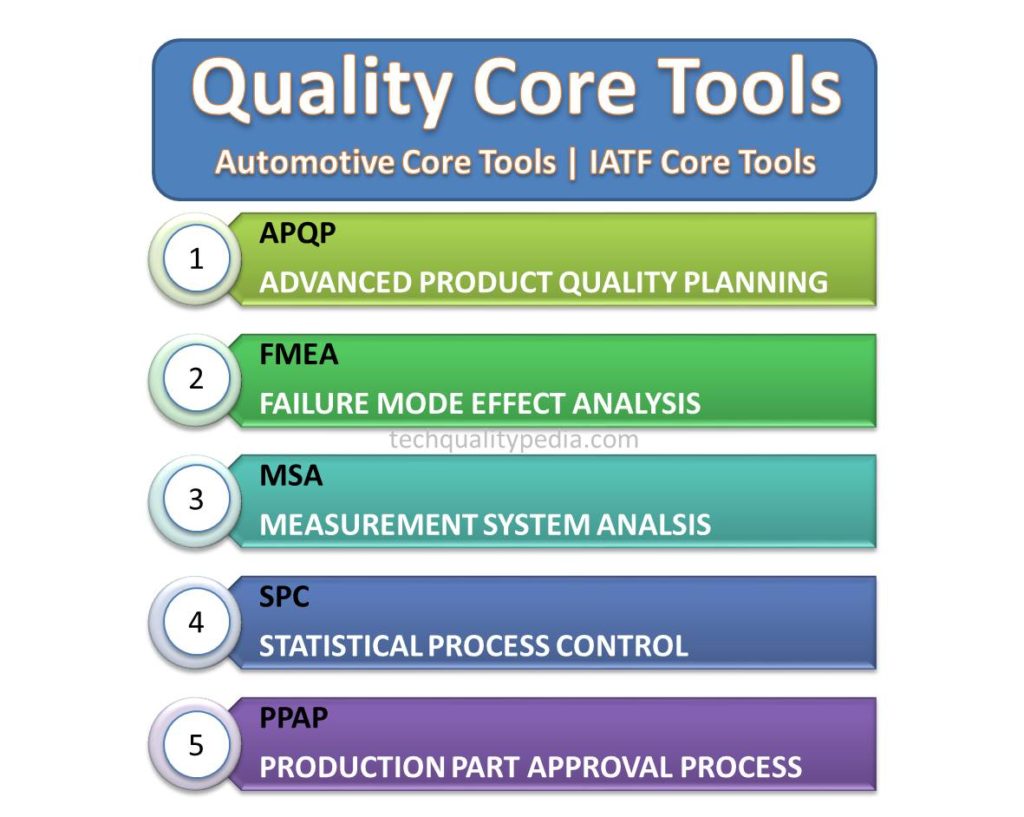
When designing & developing products or processes, the 5 IATF core tools are used that are listed below in their order of use:
- Advanced Product Quality Planning
- Failure Mode and Effect Analysis
- Measurement System Analysis
- Statistical Process Control
- Production Part Approval Process
Click on the above links to explore all Automotive Core Tools in detail.
Advanced Product Quality Planning | APQP
APQP is a structured method for defining and executing the steps necessary to ensure that a product meets the customer needs and expectations.
APQP focuses on:
- Product quality planning
- Continual improvement
APQP Benefits
- Reduced late-stage failures
- Improved project timelines
- Helps to initiate corrective measures against delayed activities
- Better communication between departments
Failure Mode and Effect Analysis | FMEA
FMEA is a systematic method for identifying potential or possible failure modes in a product or process and prioritizing preventive actions to mitigate risk.
Types of FMEA:
- Design FMEA (DFMEA): Identify and evaluates potential failures modes during product design phase.
- Process FMEA (PFMEA): Identify and evaluates potential failures modes during manufacturing or assembly process design.
FMEA Benefits
- Enhances product and process quality and reliability
- Reduces customer complaints, rejections, and warranty issues
Measurement System Analysis | MSA
Measurement System Analysis tool is used to find and evaluates the sources of variations present in the measurement systems which include appraiser, equipment, machine, and environment.
MSA Studies includes:
- Gage Repeatability and Reproducibility (Gage R&R) study
- Attribute Analysis study
- Bias, Linearity, and Stability studies
Statistical Process Control
Statistical Process Control is used to measure, record, analyze, and control the Process Variability for quality improvement. This technique is used to measure Process Capability and control quality during the production process.
SPC helps in:
- Detecting variations in the manufacturing process.
- Reducing quality defects.
- Maintaining consistent output and enhancing productivity.
- Improve product and process quality.
Production Part Approval Process | PPAP
PPAP provides evidence that all customer engineering design and specification requirements are properly understood and met by the supplier.
PPAP helps the suppliers demonstrate that their production processes consistently produce parts meeting the customer expectations or requirements.
PPAP consists of 18 possible documents.
PPAP Elements I Documents
Some key elements or documents of the PPAP process are:
- Engineering Design Records
- Process Flow Diagram-PFD
- PFMEA
- Control Plan
- MSA and SPC study
- Appearance Approval Report
- Initial Sample Inspection Report
- Part Submission Warrant (PSW)
Benefits of Using IATF Core Tools Benefits
The benefits of using IATF 16949 Quality Core Tools are:
- Improved product reliability and process quality
- Early risk detection and control
- Enhanced customer satisfaction
- Improve internal communication